
Separate the Cherokee County Property Value Types
The Cherokee Revenue property search puts several values on one screen. That does not make them interchangeable. Check each label, tax year, and source first.
| Value type | Meaning | Record source |
|---|---|---|
| Total appraised value | The Revenue appraisal used as the starting assessment figure | Property Values panel |
| Assessment value | The amount after the parcel's applicable Alabama assessment level | Property Values panel |
| Total taxable value | The tax-facing value after applicable treatment shown on the account | Property Values panel |
| Land and improvement values | The component split between site and improvements | Property Values and Detail panels |
| Sale or consideration evidence | The amount supported by a deed or transfer documentation, when available | Cherokee Probate recorded instrument |
The portal's parcel summary includes no verified last-sale-price field. So never treat an appraised or assessed figure as the price the parcel actually fetched. Consideration lives elsewhere. The recorded deed, along with any validation or deed-tax evidence, is the proper place to investigate what changed hands, subject to document access and what the instrument itself discloses.
Read Cherokee Revenue's Value Panel Field by Field
A parcel summary in the Cherokee Revenue portal can list Total Acres, Use Value, Land Value, Improvement Value, Total Appraised Value, Total Taxable Value, and Assessment Value. The Detail Information section adds more. Type, reference, description, land use, property class clues, and appraised values often appear there. Building Components, Photos, and Sketches can explain the improvement side.
| Question | Field to inspect | Why it matters |
|---|---|---|
| How much is assigned to the site? | Land Value and Use Value | Separates land treatment from structures |
| How much is assigned to improvements? | Improvement Value and building detail | Connects value to listed improvements |
| What is the overall Revenue appraisal? | Total Appraised Value | Provides the appraisal starting point |
| What amount reflects classification? | Assessment Value | Shows the account's assessed figure |
| What value remains for taxation? | Total Taxable Value and Exempt Code | Shows tax treatment, not market price |
Property class matters. One business personal-property account in Cherokee County showed an assessed-to-appraised relationship near 20 percent, but that single record should not be generalized to every real-property class.
An Eight-Year Cherokee Record Shows Change, Not a Market Trend
One account spans 2018 through 2026. Its appraised and assessed figures declined. That history covers business personal property, so it proves nothing about homes, land, or the wider Cherokee County market.
The lesson is narrower. The portal can display a multi-year pattern for a single account. Compare like with like. Match the account, property type, classification, tax year, and value field. A change can reflect depreciation, new improvements, corrected data, classification, use treatment, exemptions, or an appraisal update, and the record itself may not say which.
Note: An account history is evidence about that account; it is not a countywide index, comparable-sales analysis, or forecast of future value.
Look Up a Cherokee County Property Value
The Revenue portal accepts many search keys. Address, owner name, company, PIN, parcel, account, and subdivision all work once a Tax Year is chosen, and one address can return multiple accounts, including business personal property. Address is a common start.
- Select the tax year, choose Address, and enter the separate street-number and street-address fields.
- Open the matching summary and verify PIN, parcel, account, property address, legal description, and property type.
- Record land, improvement, use, total appraised, assessment, and total taxable values with their year.
- Read Tax History for the same value labels across available years.
- For a sale-price comparison, search the latest conveyance in Cherokee Probate and obtain the instrument when needed.
- Appraised value
- The Revenue estimate shown before the applicable assessment level.
- Assessed value
- The figure produced under the property's classification and assessment treatment.
- Assessment level
- The classification-based relationship applied between appraised and assessed figures.
- Consideration
- The sale or transfer amount stated or supported by a recorded instrument when disclosed.
- Reassessment
- A new official valuation of the property for assessment purposes.
Online access sometimes fails. Revenue also answers at the counter, by phone, or by mail at 260 Cedar Bluff Road Suite 102 in Centre, reachable at 256-927-5527 from 8 a.m. to 4 p.m., Monday through Friday.
The October 1 Cycle Shapes Cherokee Values and Names
Cherokee taxes are assessed in arrears. The Revenue Commissioner explains the snapshot date is October 1. That lag has a visible effect. The tax roll may keep a prior owner's name in an “In Care” notice. It stays there until the next year's notice goes out. The county publishes no fixed day count from deed recording to roll update.
Year selection matters too. The chosen year drives the displayed valuation. Before comparing a notice with the online record, confirm both refer to the same year. Confirm the account as well. New owners should record the deed in Probate and file the assessment return Revenue requests. Timing affects the roll, not the deed.
Compare Land and Improvement Value in Cherokee County
Land Value and Improvement Value split the appraisal. That split is diagnostic. It can reveal an added structure, a removed improvement, a land-use issue, an acreage correction, or a data problem worth raising with Revenue. Building components, photos, sketches, and detail rows often back up the listed improvement side.
Use Value stands alone. Never add it casually to other amounts. DeededAcres and GIS CalcAcres can differ, too. Keep every label intact, bring any discrepancy to Revenue, and take boundary acreage questions to the deed, the plat, and a survey when necessary.
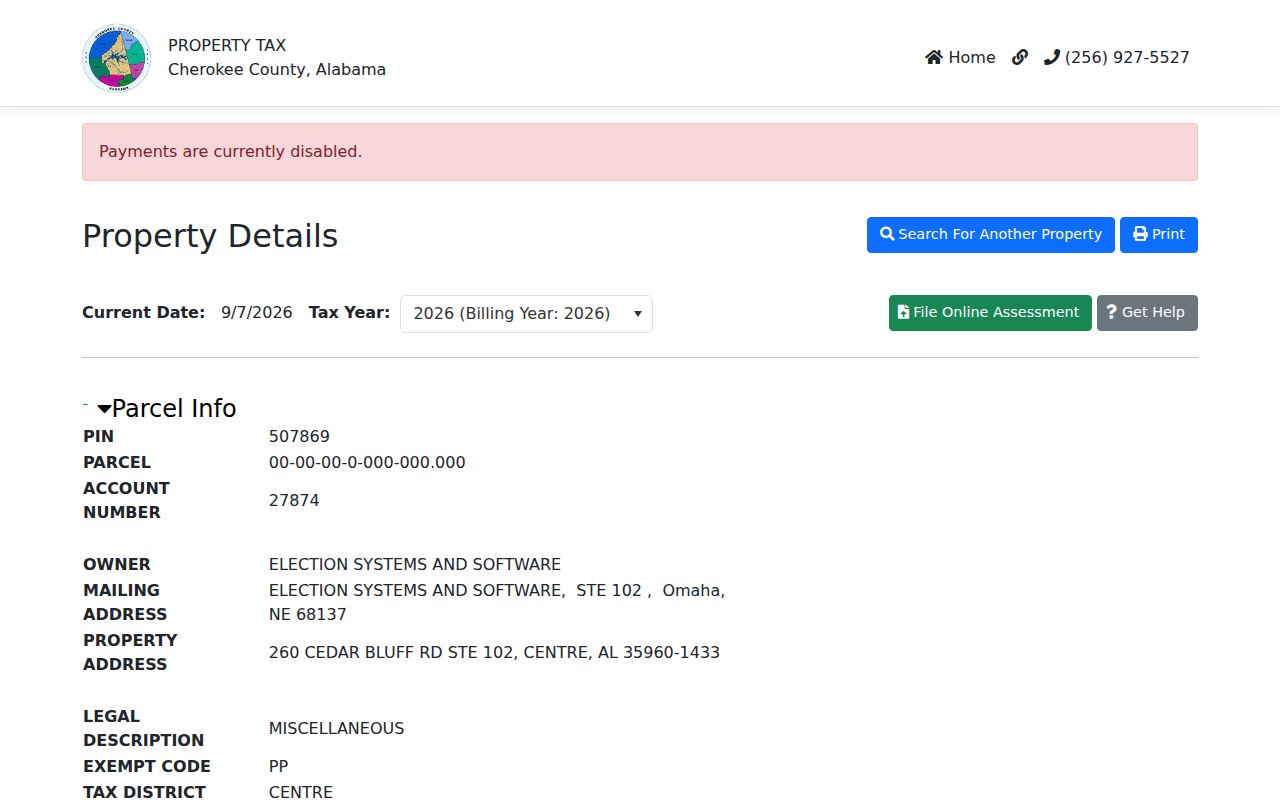
The captured Cherokee parcel summary shows how value components and annual history are grouped on an official account.
Find Sale Evidence Outside the Cherokee Tax Card
The Revenue summary is not a verified sale-price database. A recorded conveyance may carry consideration, deed-tax calculations, or supporting validation details, though the county offers no free, fully viewable sample deed with a confirmed price field.
Start with the Cherokee Probate deed index. Search by the current or prior owner, then match the legal description, document number, book and page, instrument type, and recorded date. Ask the Probate counter about images or copies when the index stops short. Not every deed amount is a market price. Family transfers, partial interests, and foreclosures can all sit behind a number. Treat the figure accordingly.
Cross-Check a Cherokee County Value Without Mixing Sources
Start with a simple worksheet. Give every figure its own line. Label it with the source, the tax year, the account, the date, and the exact field name. The Revenue card should be split across separate rows. One row for land, one for improvements, one for the appraised amount, one for the assessed amount, and one for the taxable amount. Deed consideration or other transfer evidence goes on a different row. A professional appraisal or a verified comparable sale earns a line only when its effective date and scope are known.
Then confirm the parcel itself has not changed. A split, a merge, a retired parcel, a rewritten legal description, a new building, or corrected acreage can make two yearly totals look comparable. They may not be. The GIS parcel layer offers a first clue here. Its Created By Record and Retired By Record fields point toward the change. Probate deeds and plats supply the documentary proof behind it.
State the result narrowly at the end. The Revenue figure speaks only to the county assessment for that one year. A recorded sale speaks only to that transaction, on its own terms. An appraisal supports an opinion as of its effective date and nothing more. No single source carries all the meanings of value at once.
Exemptions Change Taxable Value, Not the Sale Market
An exemption shifts tax math, not the market. The Revenue card shows an Exempt Code and a Total Taxable Value, and a code can lower the amount subject to tax without lowering what the property would sell for. The deed and the parcel boundary stay untouched. Confirm the code against the tax year you selected. Revenue handles current eligibility and the filing route. Bill payment, delinquency, exemption procedure, and Board of Equalization timing belong in the Cherokee County property tax records.
The Revenue figure is an official assessment record. It is not a promise about price. An offer, an insurance estimate, a replacement cost, a lender valuation, and a professional appraisal each answer a different question at a different moment, so gaps between them are normal. The number can also track a tax-year cycle rather than conditions on the day you view it.
Note: Compare appraised, assessed, and taxable fields separately; an exemption-related change is not proof that the underlying appraisal changed.
Know What a Cherokee County Property Value Cannot Tell You
The Revenue figure is an official assessment record. It is not a promise about price. An offer, an insurance estimate, a replacement cost, a lender valuation, and a professional appraisal each answer a different question at a different moment, so gaps between them are normal. The number can also track a tax-year cycle rather than conditions on the day you view it.
Value is not price. A Cherokee County assessed value exists for taxation. It is neither a current sale appraisal nor a guarantee of what a buyer will pay.
A Cherokee County property value has limits. For a purchase decision, rely on a qualified appraiser and recent comparable sales. For recorded consideration, the deed evidence itself controls. An error in the assessment record goes to Revenue with the PIN, the tax year, the field at issue, and supporting proof. Each number means what its source says it means. Reading it that way keeps a Cherokee County property value comparison defensible.
Keep a dated copy of whatever summary you relied on. Portal values shift with a new tax year, a correction, a classification update, or routine account maintenance. The date and the selected year are therefore part of the evidence.