
Deed Types Recorded in Cherokee
Every deed accepted for recording by the Probate Judge names the parties, spells out the land interest being conveyed, and picks up a recording reference. That reference is what makes the conveyance traceable in Cherokee County property records. A deed stands apart from a mortgage, judgment, lien, or release, even though all of those can sit in the same public index and affect the property. Knowing the difference keeps a deed records search honest.
| Deed Type | What It Does | Common Use |
|---|---|---|
| Warranty deed | Conveys the stated real-property interest with warranties in its text | Ordinary purchase transfer |
| Quitclaim deed | Conveys whatever interest the grantor holds without the same warranties | Family transfer or title cleanup |
| Executor or personal representative deed | Conveys estate property under probate authority | Transfer after an owner's death |
| Sheriff or foreclosure deed | Records a transfer resulting from a legal sale process | Execution or foreclosure trail |
| Tax deed | Records a later tax-title instrument where statutory steps support one | Tax-sale history, not the initial lien auction |
The same index holds easements, timber and mineral deeds, corrective deeds, covenants, plats, mortgages, releases, judgments, lis pendens, UCC filings, and tax-related instruments. Each one can explain a burden or a right attached to the land. None of them is automatically an ownership transfer, so read the instrument before assuming a change in the owner of record.
Cherokee Probate Keeps Deed Records
The Cherokee County Probate Office serves as the local land recorder, since Alabama assigns this duty to Probate rather than a separate county clerk here. The office records deeds, mortgages, plats, judgments and liens, UCC documents, easements, and related instruments. You will find it at 373 East Main Street, Suite 103, Centre, open weekdays from 8 a.m. to 4 p.m. The online Cherokee Probate Records index permits anonymous searching. Start there for indexed deed records. The counter still matters, though, for certified copies, old books, image access, and anything outside the online window.
Cherokee Deed Index Search Fields
Search controls shift with the record class you pick. A deed search can narrow by party name, book, document number, instrument type, description, subdivision, or recording dates. Keep date ranges in mind. A date-only search is capped at 365 days, and an all-books date-only query is limited to 90.
| Field | Input | Use |
|---|---|---|
| Search By | Record-class dropdown | Choose deed, mortgage, plat, judgment, tax sale, or all books |
| Name fields | Last First Middle or entity name | Find grantors, grantees, and other indexed parties |
| Book / Document # | Recorded reference | Retrieve a known instrument |
| Instrument Type | Portal dropdown | Narrow deed or encumbrance form |
| Subdivision / Description | Text | Connect a land description or plat name |
| Start / End Date | Date range | Limit transfers to a known period |
A deed result can display Book #, Document #, Grantor, Grantee, Instrument, Pages, Recorded, and Description. Treat those fields as index clues only. Read the document itself, or get a certified copy. Do that before relying on the full legal description or conveyance terms. The official recorder search screen shows the fields the Probate index presents.
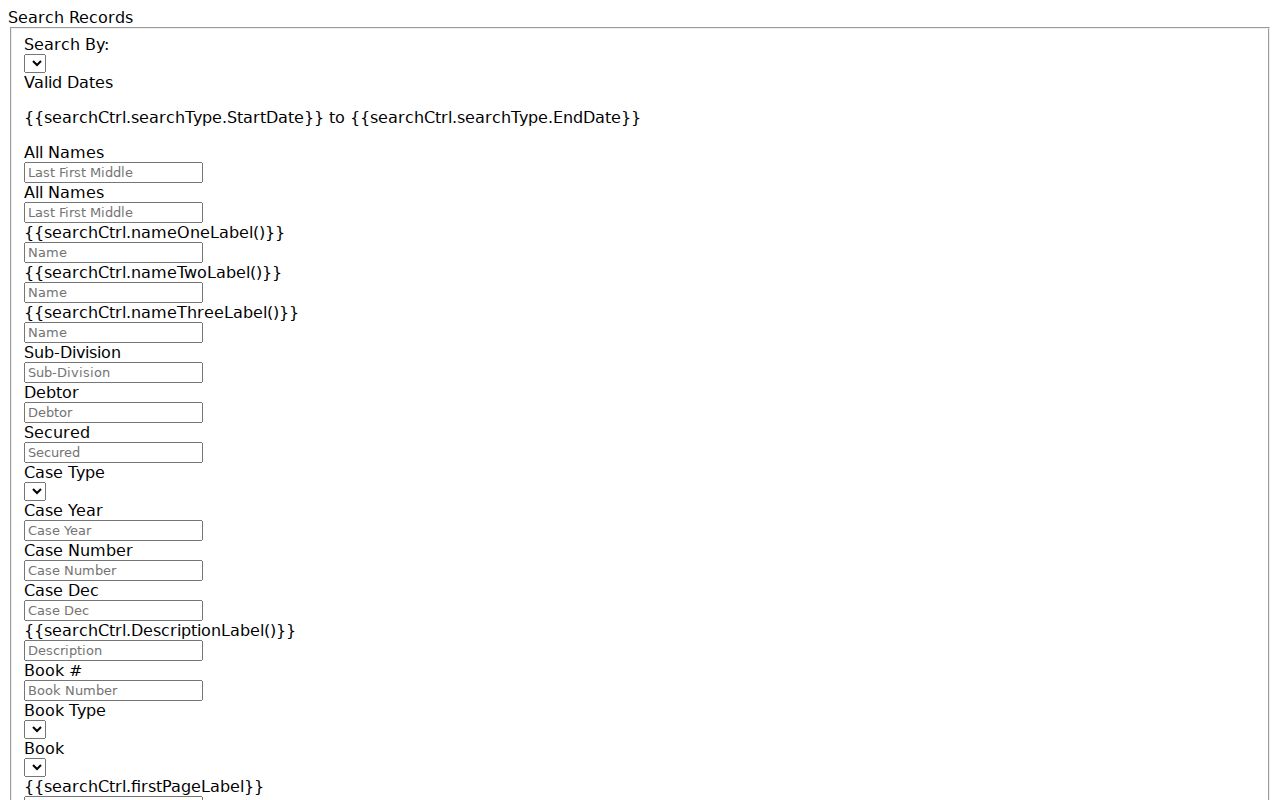
Several search paths open from that screen. That flexibility helps when a single name spelling returns too many hits, or far too few.
Cherokee Deed Coverage Has Cutoffs
Online deed coverage starts June 25, 1978. Mortgages begin January 1, 1988. Plats reach back to January 1, 1923. The "all books" option starts at that 1978 date. None of these cutoffs means earlier records are gone. They simply mark where the digital index ends. For an older chain of title, pull the source-of-title book and page from the last online deed. Take it to Probate. The Alabama Department of Archives and History microfilm catalog can extend the trail. Surviving courthouse books, FamilySearch, and Cherokee County Library genealogy material can extend it too. Archive images and family-history leads still need to be reconciled with official land records. Confirm them before you trust them.
Note: Save the coverage dates displayed by the portal because later digitization can change the available starting point.
Trace Cherokee Grantors and Grantees
A grantor conveys the stated interest. A grantee receives it. String every conveyance tied to the same land together and you have a chain of title. Start from the newest known owner, but verify each step against the legal description, parcel clues, and recording reference rather than a shared surname.
- Find the present owner's acquisition deed with that owner as grantee.
- Read the grantor and the source-of-title book/page from the deed.
- Search that grantor as an earlier grantee and match the same land.
- Repeat until the portal cutoff, then move to deed books and microfilm.
- Grantor
- The party conveying the stated interest.
- Grantee
- The party receiving the stated interest.
- Chain of title
- The linked sequence of recorded transfers for the same land.
- Book/page or document number
- The recorder's reference used to identify an instrument.
Odd Labels in Cherokee Deeds
The public index carries 312 instrument labels, and they are not uniform. Historical shorthand, duplicate variants, and plain misspellings show up. Entries include "Administrators Deed," "Judgement," "Tax Lein," and several versions of "Ucc-1." Don't try to fix the portal. Search more than one label instead. Run the broad DEED class first, then filter by instrument type. Try a trust name and its trustee. Try an estate and its personal representative. Try every plausible spelling of a party. A corrective deed, assignment, release, or memorandum may hide under a narrower label than the transaction suggests.
Cherokee Legal Description Requirements
The county's recording requirements are blunt about one point. A street address is not a legal description. A recordable deed needs a complete description. It must include a separately stated source-of-title deed book and page, required signatures with notarization, and an Alabama Real Estate Validation or RT-1 attestation where applicable. Subdivision property should also identify its plat book and page. Accepted descriptions can take several forms. Section, township and range works. So do subdivision lot and block, metes and bounds, tax abbreviations, and mineral descriptions. The deed must state who prepared it. It must address the listed marital-status requirements. It must also carry an original signature or certified court copy. One caution applies to the tax roll. A Revenue tax card may abbreviate its legal-description field. Never copy it as though it were the deed's full wording.
Liens Beside Cherokee Deed Records
Deeds rarely travel alone. Mortgages, assignments, satisfactions, judgments, lis pendens, easements, covenants, and releases sit beside them in the deed records. A mortgage records a security interest in the parcel. A satisfaction or release shows that the obligation ended. A plat, meanwhile, defines lots and common areas rather than conveying anything. None of these instruments should be confused with the deed that actually transfers ownership.
Buyers at a Cherokee County tax-lien auction gain no title. The Revenue Commissioner's own process grants the purchaser a lien certificate. Redemption and later foreclosure rules are set by Alabama law. Easements and covenants survive the tax lien. So work through the Probate tax-sale and redemption classes plus the current Revenue record whenever that history appears.
Estate Transfers in Cherokee Records
Estate transfers fill many Cherokee deed record pages. Family land can pass through an executor, administrator, personal representative, conservator, or trustee deed. The index carries matching deed and Probate Court labels. A will alone rarely moved the land record. Match the estate case, the death information, the court authority, and the eventual deed before drawing conclusions.
Obituaries and family files help with names and relationships, but the Probate instrument is the bridge back to title. Search the decedent, estate, representative, and grantee. Then compare book, page, legal description, and recording date against the prior deed, and use the former owners search to extend that chain backward.
Two Fires Complicate Old Cherokee Deeds
Two courthouse fires damaged Cherokee County's record base. The state archive lists blazes in 1882 and 1895. That history can interrupt a nineteenth-century chain of title. It does not mean every older deed burned, though, because later source-of-title clauses, surviving deed books, Probate minutes, tax lists, census records, newspapers, and cemetery or church material often preserve names and land clues.
Treat the archive path as a bridge. Final proof still comes from a surviving deed, plat, or court order with a matching legal description. The ADAH courthouse-fire record confirms the events. Its research service and microfilm catalog show what can be checked next.
Order a Cherokee Deed Copy
Try the online action control first. Do not assume every image is free or downloadable. For a plain or certified deed copy, call the Probate Office at 256-927-3363 or visit its Centre counter. A mail request should identify the instrument and include payment plus a self-addressed stamped envelope.
Fees are published, not guessed. The recording fee schedule lists $13 for the first page and $3 for each additional page on many instruments. Certification, scanning, surcharge, extra-name, deed-tax, and mortgage-tax components vary with the filing. Those figures cover recording, not online image pricing. Confirm the current total before sending funds.
Email works too. Questions can go to probateoffice@cherokeecounty-al.gov, the published Probate address. A precise request should distinguish an ordinary informational copy from a certified copy and name the instrument class, whether deed, mortgage, plat, judgment, release, or something else.
Recorded, not guaranteed. Cherokee County deed records show accepted instruments and index data. They are not a title opinion, and unrecorded interests or indexing errors can still require professional review.
Note: Give Probate the document number or book/page, party names, instrument type, and recording date to reduce copy-search delay.