
Read Cherokee County's Current Owner Card
The Cherokee County Revenue property search opens a detail card for whatever tax year you pick. Its Parcel Info area works as the practical record card. That is where a current-owner check starts. The card keeps three things separate. The person or entity assessed comes first. Then the place where notices go, and the physical location of the property.
| OWNER | The taxpayer name carried on that year's assessment roll |
|---|---|
| MAILING ADDRESS | Where Revenue sends tax correspondence, which may be a PO Box or out of state |
| PROPERTY ADDRESS | The situs location, including street, unit, city and ZIP formatting |
| PIN / PARCEL / ACCOUNT | Stable cross-reference keys for Revenue, GIS and follow-up work |
| LEGAL DESCRIPTION | The description clue used to match the parcel to a recorded instrument |
| Tax History OWNER(S) | Names carried in prior tax years, useful only as supporting clues |
The OWNER field names no occupant. Nor does it spell out vesting. A company can appear as the current owner of record, with a mailing address that belongs to an accounting or notice location. Use the card for the property question at hand, and skip republishing a private mailing address.
Check the Tax Year Before You Verify a Cherokee County Owner
Revenue requires a Tax Year selection. The portal defaults to 2026. But the owner shown belongs to the chosen roll, not to some abstract idea of ownership today. Cherokee County assessments take an October 1 ownership snapshot. A deed recorded after that date can leave the tax name one transfer behind.
An “In Care” notice can preserve a prior owner. It often appears during the next-year transition, so treat it as a timing clue. Before comparing the latest conveyance, copy the PIN, parcel number, legal description, and tax year.
Note: A selected tax year explains which assessment roll supplied the owner name; it does not establish the date title changed.
Separate Cherokee County Mailing and Situs Fields
Mailing and situs answer different questions. One travels; the other stays put. Cherokee County's sample company card shows an LLC with an out-of-state mailing address while the property sits on Cedar Bluff Road in Centre. That is a concrete reminder that mail geography proves neither where the land lies nor who occupies it.
- Owner of record
- The person or entity named on the assessment roll for the selected year.
- Assessment roll
- The tax-year record Revenue uses for appraisal, assessment and collection.
- Situs address
- The physical address assigned to the property or account.
- Recording lag
- The interval during which a new deed is recorded but the tax roll still carries an older name.
See the Cherokee County Owner Field in Context
The county's sample Revenue parcel summary places OWNER in context beside PIN, parcel, account, mailing address, property address, and legal description. Seeing the fields together beats a name alone.
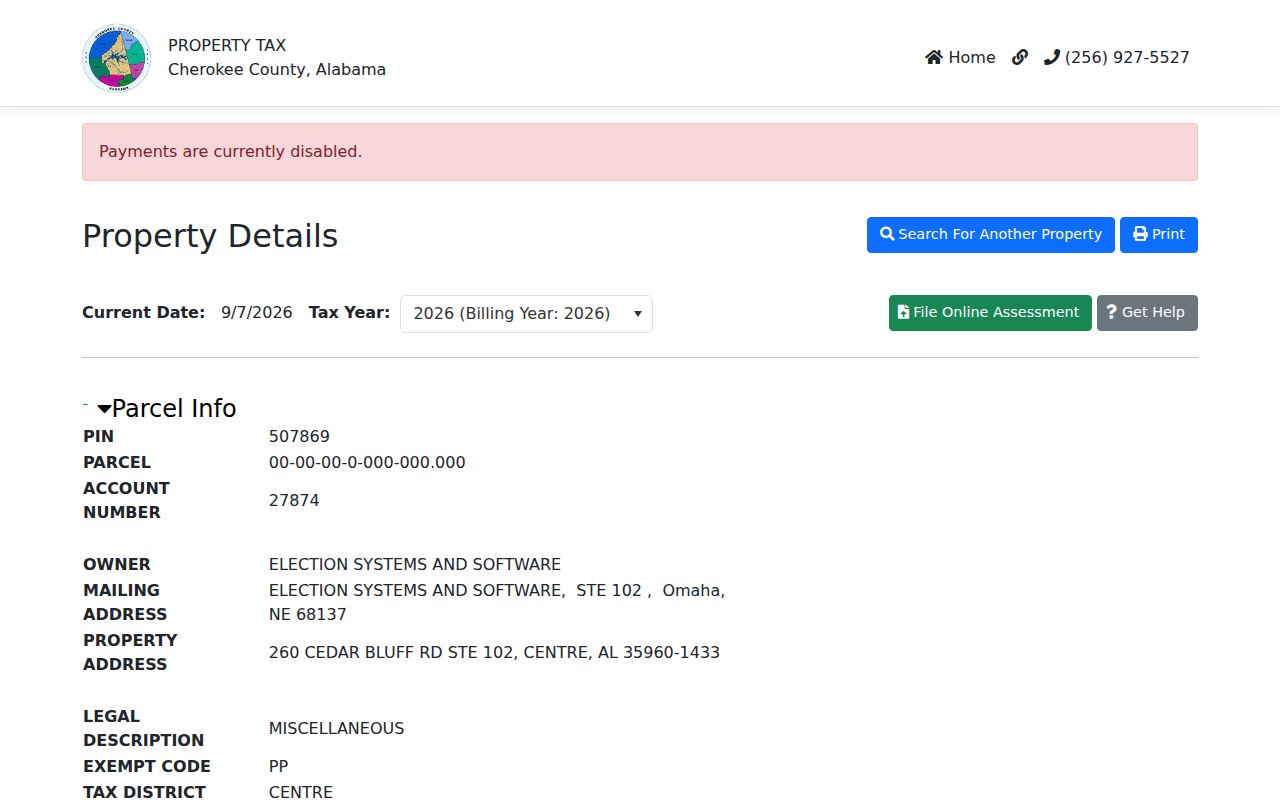
A name alone is a weak match. One spelling can fit many people, entities, or parcels. Treat the card as a linked set of fields, never a loose name result.
Verify a Cherokee County LLC or Trust Name
Copy a company owner's exact punctuation and spacing. Search that spelling in the Probate deed records. When entity status or filings matter, consult the Alabama Secretary of State Business Services. A registered agent is an entity contact, not proof of ownership.
Trust and estate labels need care too. The deed may name trustees, co-grantees, an executor, or a personal representative. The tax card shortens that wording. For the current owner of record, the newest recorded instrument carries the day. Its legal description settles it as well.
Confirm the Current Cherokee County Owner Against Probate
A current-owner check ends at the newest deed. Not at the first name found online. Cherokee Probate permits anonymous searching, and its deed rows list grantor, grantee, instrument, book or document number, recording date, pages, and description.
- Open the Revenue summary for the correct tax year and copy OWNER, PIN, parcel and legal description.
- Search the Cherokee Probate Records index for the latest deed involving that owner or parcel description.
- Read the newest deed's grantee and compare its legal description with the Revenue card.
- If an entity or trust appears, preserve its exact recorded name and roles rather than substituting a person's name.
- Grantee
- The party receiving an interest in the recorded deed.
- Deed reference
- The book, document number, recording date and pages that locate the conveyance.
- Legal description
- The land description used to confirm that the deed and tax parcel concern the same property.
Resolve a Just-Recorded Cherokee County Sale
For a recent closing, search Probate with the seller as grantor and the buyer as grantee. Then compare recording date and description. The newest deed can outrun the October 1 snapshot. Revenue may still need an assessment return before its roll changes.
Timing matters. The Cherokee County roll can lag a recent sale; the latest valid recorded deed is the more current ownership record.
Ask Cherokee County When the Online Names Conflict
Some owner questions need the counter. That includes a deed too new for the index, an image that will not open, or identifiers that do not line up. The Cherokee County Probate Office records instruments at 373 East Main Street, Suite 103, in Centre. The Revenue Commissioner can explain the selected assessment roll and parcel identifiers through its official office site.
The Alabama Open Records Act is the fallback. It covers public county records the portal route missed. Cherokee County requires its form, proof of Alabama residency, and in-person submission. Fees and staff time can apply.
Review the Full Cherokee County Current-Owner Result
The owner name means little alone. Revenue's Parcel Info carries PIN, parcel, account number, mailing address, property address, legal description, exempt code, and tax district. Property Values and Subdivision Information separate two accounts with similar names or locations. Tax History lists yearly OWNER(S). But a historic row never proves the same party still holds title now.
One Cedar Bluff Road search can return a business personal-property account alongside another company account at the same street. So an address hit is not enough. Weigh description, account type, and parcel identifiers before carrying a name into Probate. Conventional land ties to a deed and legal description. A business personal-property card may not.
Read the Cherokee County Deed's Current Grantee Exactly
Probate results give you the grantor, the grantee, the instrument type, a book or document number, the recorded date, page counts, and a property description. The grantee is whoever received the recorded interest. Copy the name exactly as written. Keep every listed grantee, and keep the form of the name intact. Never shorten an LLC. Never drop a co-owner. Never swap a trustee for a beneficiary on a hunch.
Treat the online index as a finding aid, nothing more. When no image is available, get the instrument straight from the Probate Office. The same applies when the deed's wording matters to a legal decision. The office can also confirm what it charges for images and certified copies. No precise fee is published online.
Keep Cherokee County Current-Owner Contact Separate from Ownership
A mailing address serves one purpose: delivering tax notices. It might point to an out-of-state owner. It could also be a post-office box, an entity's office, or another authorized recipient. It does not reveal where the owner lives. It does not prove who occupies the property, either. For a genuine boundary, sale, or estate question, be careful. Use only the contact detail that purpose requires.
Alabama court rules and other laws protect certain private information. Never merge a tax address with voter, court, jail, or unrelated data. Do not assemble a personal profile. Once the tax roll and deed agree, the current-owner task is finished.
Use Cherokee County Tax History as a Timing Check
Revenue's Tax History shows the year, OWNER(S), total tax, paid status, who paid, and the appraised and assessed amounts. Lining up adjacent years can show when the assessed owner label changed. It cannot pin down a closing or recording date. Payment by a named party does not make that person the owner, either.
When the current card and an earlier tax row disagree, search Probate records around that transition. A deed recorded late in one year may not surface until a later assessment cycle. Record both the portal's selected year and the deed's recording date. Then the apparent conflict explains itself.
Find the Cherokee County Current Owner Without a Clean Address
Revenue's alternative modes rescue you when a situs address is missing. They also help when it is newly assigned or formatted oddly. PIN and parcel searches work best in one case. Copy the number straight from GIS or an older card. Account mode tracks the tax account itself. Subdivision search finds lot records. Name and Company modes help once the owner is known.
For surnames, try starts-with and contains matching. In Company mode, use the entity's exact recorded wording. A hyphenated parcel number's segments carry meanings the public source never published a key for. Copy the whole thing. Compare the legal description it returns.
Know the Evidence Behind a Cherokee County Current-Owner Conclusion
A solid conclusion cites the Revenue card's tax year, OWNER, PIN, and legal description, alongside the newest deed's grantee, instrument, recording date, and locator. Note any gap between the two sources. Keep entity and trustee names exact. That evidence beats a screenshot or a name copied without context.
None of this is a title opinion. Unrecorded interests, recording defects, later filings, or litigation can call for a professional examination. For a transaction, boundary dispute, or estate distribution, a qualified Alabama title professional or attorney can review the complete record.
Use Cherokee County Current Owner Data Responsibly
Public owner fields support purchase checks, boundary questions, estate work, and civic research. They do not justify compiling a personal profile or treating a mailing address as a residence. Any contact about a legitimate property issue should stay limited, respectful, and grounded in the official record.
Lawful use. Cherokee County owner information may be used for legitimate property research. Never use it to harass, intimidate, stalk or target anyone.