
Read the Cherokee County Property Tax Record
The public Cherokee County Revenue property search puts assessment and collection data on one account summary. Start with the four value fields. Then read the tax status for the chosen year. A zero or paid balance answers a collection question only, and it says nothing about a mortgage, judgment, easement, or other recorded claim against the parcel.
| Field | What It Shows | Where |
|---|---|---|
| Total appraised value | The Revenue appraisal for the account | Property Values panel |
| Assessment value | The assessed amount after the parcel's classification level | Property Values panel |
| Total taxable value | The amount remaining after applicable treatment and exemptions | Property Values panel |
| Exempt code | The exemption code carried on the selected account | Parcel Info panel |
| Taxes and balance due | Charge, penalties or interest, payments, and amount still owed | Tax Information panel |
| Tax district | The district assigned to the account | Parcel Info panel |
Land, improvement, use, appraised, assessed, and taxable values can all differ without contradicting each other. Each one serves a separate part of the assessment calculation. The last sale price is different again. The tax card publishes no such field. For a closer look at these terms, see the Cherokee County property value guide.
Search Cherokee County Tax Accounts Seven Ways
The Revenue portal stays public, with no login needed for searching. Its Tax Year selector matters, because each result reflects one yearly roll. The 2026 screen offered seven search modes. Those extra modes help when an address is incomplete. They also help when one street returns more than one kind of account.
| Search mode | Entry to use | Best tax task |
|---|---|---|
| Name | Last name, plus optional first name; starts-with or contains | Find all accounts under an individual |
| PIN | Portal PIN | Return to one known tax identity |
| Company | Company or LLC name | Separate business ownership from personal names |
| Parcel | Parcel number | Match an account to land records |
| Account | Tax account number | Check a known bill |
| Subdivision | Subdivision name | Find accounts within a named development |
| Address | Street number and street wording | Begin from a physical location |
PIN, parcel number, and account number are three distinct identifiers. Copy the exact value from a result rather than moving punctuation between fields. One Centre address returned both business personal-property accounts and an LLC. That mix shows why care matters. Each row must be opened before you assume it describes the land itself.
Note: The selected tax year controls the roll displayed, so repeat a search in another available year when comparing tax history.
Cherokee County Splits Land, Improvements, and Use Value
A Cherokee County parcel summary can list Total Acres, Use Value, Land Value, Improvement Value, Total Appraised Value, Total Taxable Value, and Assessment Value. These fields reward close reading. Building components, sketches, photos, and detailed land-use lines may add context. An owner can isolate whether a change came from the land, from an improvement, or from tax treatment alone. It might be the land. It might be an improvement. Or it might be tax treatment alone. The total stops being one unexplained number.
- Appraised value
- The Revenue estimate shown for assessment purposes before the parcel's assessment level is applied.
- Assessed value
- The appraised amount adjusted under the applicable Alabama property classification.
- Taxable value
- The value used after relevant exemptions or tax treatment shown by the account.
- Tax lien
- A statutory claim tied to unpaid tax; buying a lien certificate does not itself convey ownership.
One sample account showed roughly a 20 percent relationship between appraised and assessed figures. It was a business personal-property record, though. It cannot set the ratio for every parcel class, so apply the classification that actually appears for the property.
The October 1 Snapshot Can Preserve a Prior Owner
Cherokee County property tax records are collected in arrears. The arrears are based on the October 1 ownership snapshot. The Revenue Commissioner explains that an "In Care" notice can appear. It can name the prior owner of record on that date. The new owner's name should first appear on the next year's notice. The county publishes no guaranteed number of days for a roll update. Until then, a bill can lag behind the deed.
Two records, two clocks. The newest recorded deed can be more current than the tax roll. An “In Care” line is a timing clue, not proof that the conveyance failed.
After a new deed is recorded in the Probate Office, the owner should file an assessment return with it. That step feeds the next tax roll. A private closing agreement may prorate the year's taxes between buyer and seller. The county itself does not prorate them. This explains a lot. A bill name, the payment duty, and current title can point in different directions at first.
Cherokee County Tax Due Dates and Payment Channels
The Revenue Commissioner's property information states that Cherokee County property taxes are due October 1 and become delinquent after December 31. Interest and late charges start after January 1. Search first, open the right year, and confirm the displayed balance before paying anything.
- Online card payment carries a stated 2.75% plus $0.30 fee.
- Online ACH payment carries a stated $2 fee.
- The office accepts cash, check, money order, Visa, and MasterCard.
- Mail goes to Dustin St. Clair, Revenue Commissioner, 260 Cedar Bluff Road Suite 102, Centre, AL 35960.
- Phone help is available at 256-927-5527, Monday through Friday, 8 a.m. to 4 p.m.
Payment sits apart from the free public search. Keep the confirmation with the tax year and account number. A "paid" mark in the tax history reports one year's collection status, not a release of every lien recorded elsewhere in Cherokee County.
Look Up a Cherokee County Tax Bill Step by Step
Any tax-bill review should preserve the selected year, the account identity, and the payment detail. That habit matters. It keeps a current balance from being mistaken for a full history, and keeps an account at the same address from being mistaken for the intended parcel.
- Select the tax year in the Revenue property search, then choose Address, Parcel, PIN, Account, Name, Company, or Subdivision.
- Open View/Details for the matching row and verify PIN, parcel, account number, property address, legal description, and tax district.
- Read Taxes, Penalties/Interest, Subtotal, Amount Paid, Balance Due, last payment date, and paid-by information together.
- Review Exempt Code and the appraised, assessed, and taxable values; then compare Tax History if the question spans years.
- If the account is delinquent, check the official insolvent list and current auction material, then call Revenue before relying on its status.
Print the search date on any result, since balances and penalties can change. When online access fails, the Revenue Commissioner offers counter, phone, and mail channels at the Centre administrative building for Cherokee County taxpayers.
Trace Exemptions Through the Cherokee County Account
The parcel card exposes an Exempt Code. The Revenue site supplies the county's exemption route. An exemption changes tax treatment; it does not rewrite the appraised value or transfer ownership. Confirm the code belongs to the selected tax year. Check that it matches the account before drawing any conclusion from it.
Eligibility and supporting documents depend on the exemption sought. Contact the Revenue Commissioner's office rather than inferring eligibility from a neighboring parcel. Bring or cite the PIN, parcel number, account number, and recorded deed. Include the tax year in question. If a deed was just completed, file the assessment return the county requests. Submit it along with that recorded instrument.
Note: An exemption code answers a tax-treatment question; it does not certify occupancy, title, a parcel boundary, or current market price.
Insolvent Lists and the 2026 Cherokee Tax-Lien Auction
Cherokee County's Revenue office publishes insolvent-property lists along with annual auction guidance. Its 2026 tax-lien auction FAQ lays out the key dates. The online auction runs through GovEase on April 30. Registration opens March 30, and payment is due May 8. Those deadlines move from year to year. Confirm them on the current county page before acting.
What sells is a lien certificate, not the parcel itself. The FAQ walks through notice requirements, bidding, redemption rights, and lien priority. It also tells bidders to investigate value, title defects, and other encumbrances on their own. Covenants and easements survive the sale. A purchased tax lien wipes out none of them. The homework falls on the bidder.
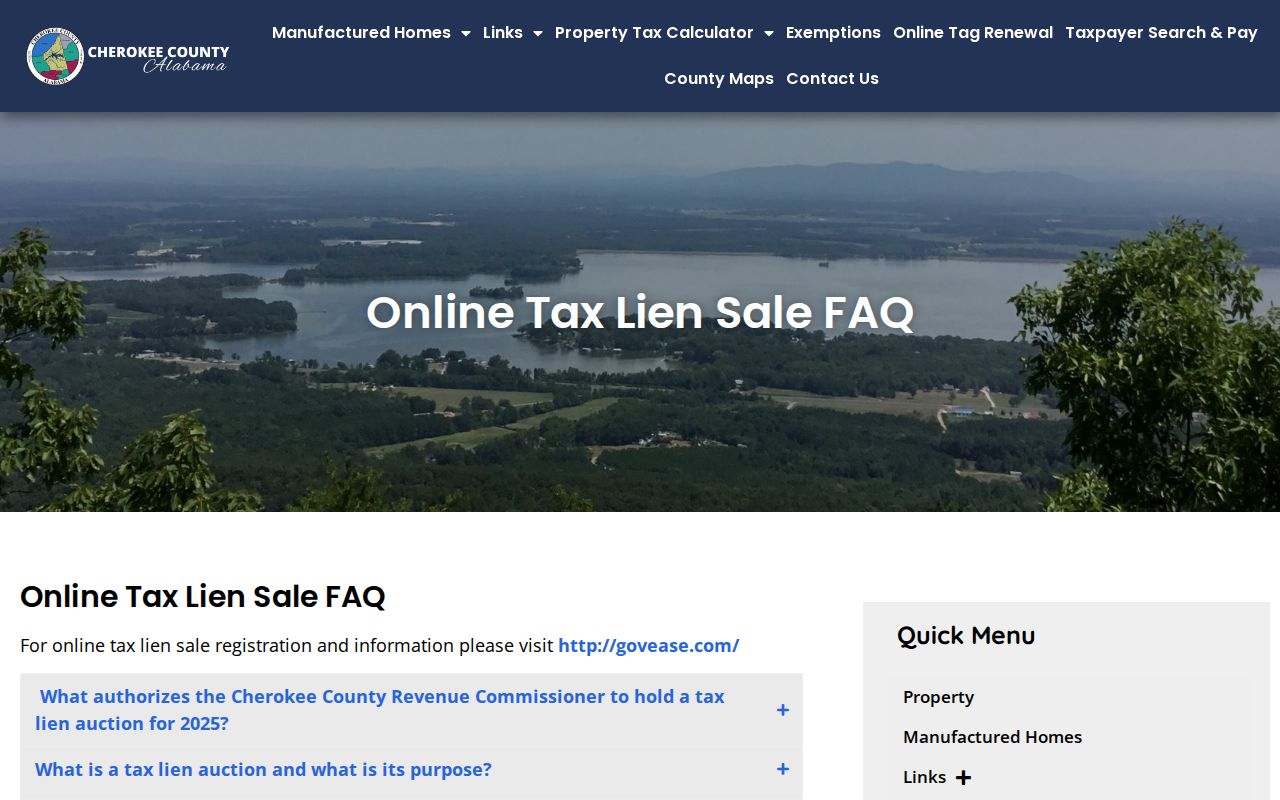
The official FAQ image below captures the county source used for those auction distinctions.
Note: A lien certificate is not a deed, and an auction listing is not proof that the listed account will remain available for bidding.
Contest a Cherokee County Assessment with Evidence
Start by checking the basics. Verify the parcel number, tax year, land and improvement values, property class, acreage, sketches, and exemption code before questioning anything. Then contact the Revenue Commissioner about an informal review and the Board of Equalization process. The county publishes no fixed annual appeal deadline. It also publishes no single verified appeal form. Ask the office directly rather than guessing at a filing date.
Confirm the appeal window. Ask Revenue at 256-927-5527 for the current Board of Equalization calendar and filing method as soon as the notice arrives.
Good evidence makes the case. Bring the assessment notice, a parcel summary, photos, and measurements. Bring a recent professional appraisal when one exists. A documented data error or well-chosen comparable sales can also support the challenge. Keep proof of delivery and the office's response. Remember that tax payment and value review are separate tracks. Ask whether a pending appeal changes any payment duty in the meantime.
Where Cherokee County Property Tax Records Stop
A tax card has clear limits. It shows the Revenue roll owner, addresses, legal-description shorthand, values, exemptions, district, and payment history. It cannot certify title. It cannot prove a legal boundary, and it cannot establish a sale price. Nor does it reveal every mortgage and judgment attached to the land. Was there a recent conveyance? Is an encumbrance in question? Then compare the tax result with the Cherokee Probate Records index.
The portal cannot always resolve the right account. Use the Revenue counter, phone, or mail route instead. Probate handles recorded conveyances and liens. A licensed surveyor supplies boundary evidence. A qualified appraiser offers a current opinion of market value. Keep those roles separate. That way Cherokee County property tax records serve their intended purpose well. They are never asked to prove more than they can.