
Start a Cherokee Property Records Search
Cherokee County splits its property records among the Revenue Commissioner, the Probate Office, the GIS service, and the courts. Municipal offices hold a share as well. Start with what you already know. An address or owner name fits Revenue's assessment search. A grantor or grantee belongs in Probate's recording index. A parcel number bridges the tax roll and the GIS map. No single system holds the entire trail. Expect to move between them. The offices agree on the parcel, legal description, and parties. Each serves a different purpose and date. The tax roll names the assessment owner for a chosen year. The deed shows how an interest was conveyed. GIS places the parcel on the ground, and a recorded plat carries more boundary weight than any on-screen linework.
- Search Revenue by address, name, company, PIN, parcel, account, or subdivision.
- Copy the owner spelling, PIN, parcel, account, and legal-description clues.
- Search Probate for the latest deed and related recorded instruments.
- Compare the same PIN and description with the GIS parcel layer.
- Request certified or older records from the office that keeps them.
Where Cherokee Keeps Property Records
Centre serves as the county seat and the practical hub for Cherokee County property records. Probate records conveyances and encumbrances. Revenue handles assessment and tax accounts and supplies the county's mapping link. The Circuit Clerk keeps trial-court files that can affect land, so route each request to the office that actually holds the record instead of sending one broad inquiry to the county.
Cherokee County Probate Office
373 East Main Street, Suite 103
Centre, AL 35960
256-927-3363
Cherokee Revenue Commissioner
260 Cedar Bluff Road, Suite 102
Centre, AL 35960
256-927-5527
Cherokee Circuit Clerk
373 East Main Street, Suite 102
Centre, AL 35960
256-927-3637
Search Cherokee Revenue Records
The Revenue Commissioner property search offers the fastest route from an address to an account. A tax-year selector picks the assessment roll to query. Search By modes cover Name, PIN, Company, Parcel, Account, Subdivision, and Address. Name mode adds starts-with and contains matching. That helps when a spelling is uncertain.
| Search mode | Input | Best use |
|---|---|---|
| Address | Street number and street text | Known property location |
| Name / Company | Owner or entity wording | Accounts tied to a party |
| PIN / Parcel / Account | County identifier | Precise cross-reference |
| Subdivision | Recorded or roll name | Lots with uncertain streets |
A result row shows description, account, parcel, year, billing year, PIN, total tax, and balance due, and it opens into a fuller summary. Payment itself happens elsewhere. The Cherokee County property search page walks through the full mechanics and every field. The official search screen appears below.
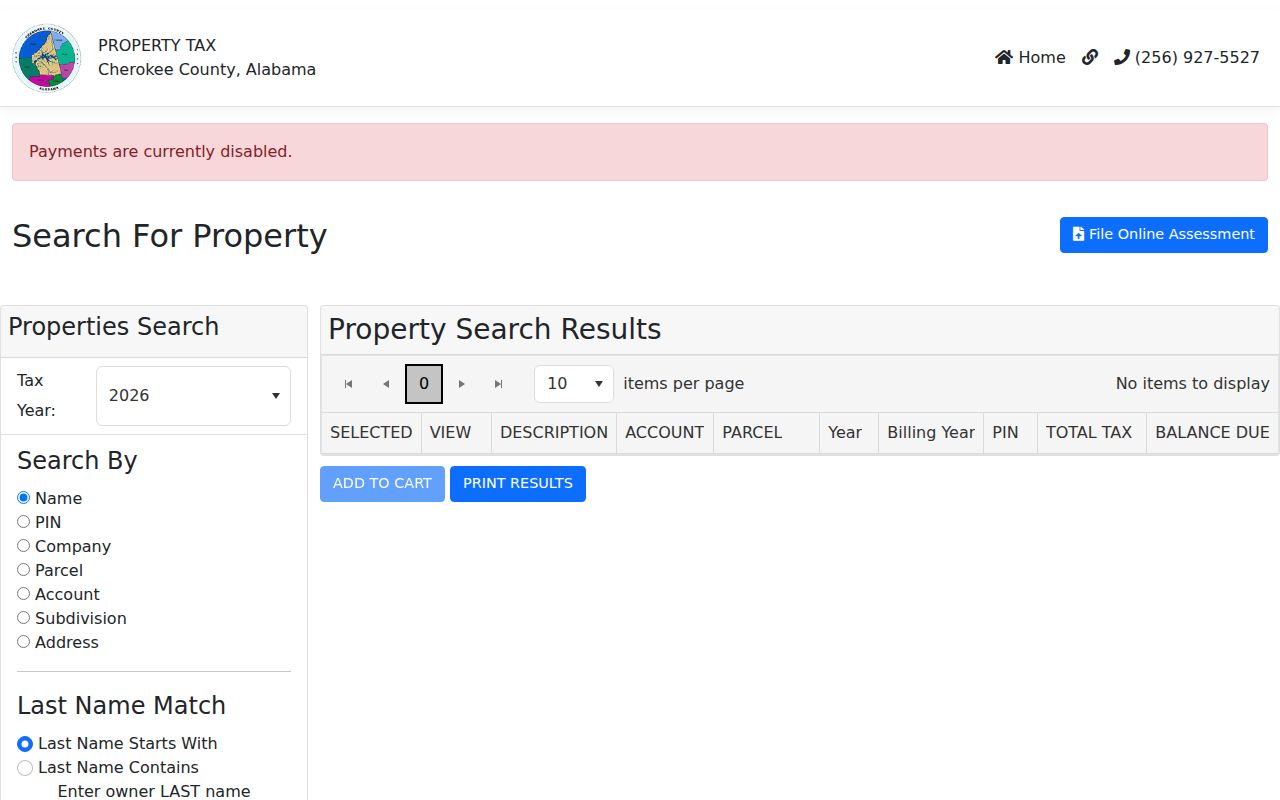
Seven search modes make the assessment roll a flexible first stop. Save the selected tax year with any result you keep, since the roll changes annually and a match without its year can mislead later.
Cherokee Probate Records and Deeds
The Probate Judge acts as Cherokee County's land recorder. The public Probate Records index spans deeds, mortgages, plats, judgments, UCC filings, easements, tax-sale instruments, and many other classes. Deeds are indexed online from June 25, 1978. Mortgages follow, with coverage beginning January 1, 1988. Plats reach back furthest, and the online index starts January 1, 1923. A deed result can show grantor, grantee, book, document number, instrument, pages, recording date, and description. That boundary only marks where the online index starts. It is not proof that earlier deeds never existed. The counter, surviving books, state archives, and microfilm extend a search further back. For a chain-of-title and copy process, use the Cherokee deed records resource.
Note: The portal did not establish that every deed image is free, so confirm image and certified-copy access with Probate.
Read a Cherokee Tax Card
A Revenue summary is much richer than its result row. Parcel Info can show PIN, parcel, account, owner, mailing address, property address, legal description, exemption code, and tax district. Other panels can list taxes, penalties and interest, payments, acres, land and improvement values, appraised, taxable, and assessed figures, subdivision data, building components, sketches, photos, and tax history.
The owner field reflects the selected assessment cycle. Cherokee Revenue explains that the county assesses as of October 1 of the prior year, so an “In Care” notice can retain a prior owner until the next roll. The newest recorded deed may therefore be more current than the tax name after a recent closing.
The official company-account sample shows the address distinction.
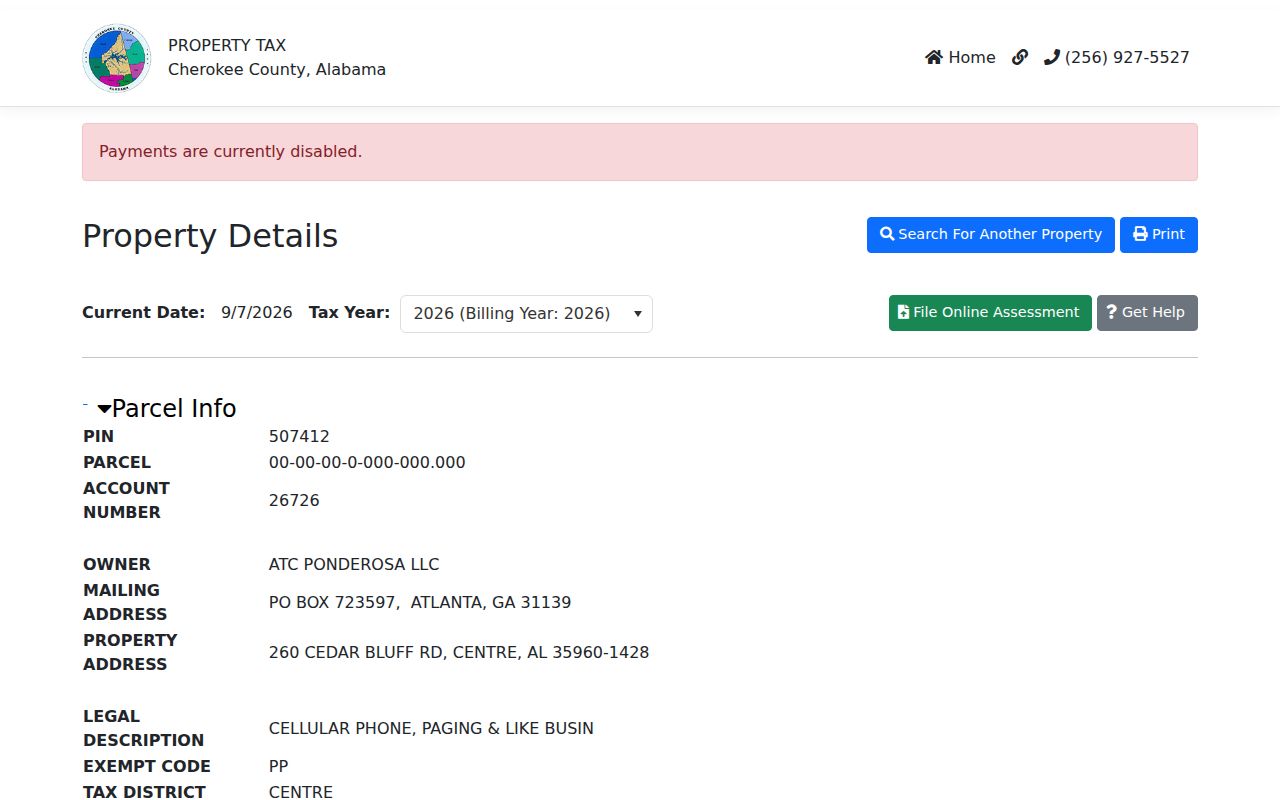
An out-of-state mailing address paired with a Centre situs shows why mailed notice, physical location, and ownership evidence must stay separate fields in any property search.
Map Cherokee Parcels with GIS
The Revenue mapping entry ties property records to a public GIS service. Its parcel layer is rich. PIN, PPIN, parcel ID, owner, previous owner, situs, legal description, values, acreage, neighborhood, tax year, and geometry all appear. Additional layers cover roads, subdivision text, districts, and building footprints. GIS works best for locating a parcel, identifying adjacent land, and comparing tax identifiers. It is not a survey. A deed description, a recorded plat, and a licensed field survey answer legal boundary questions. Parcels can also carry clues about a creation or retirement after a split or merge.
Types of Cherokee Property Records
Every record set has its own keeper, its own key, and its own legal weight. The strongest Cherokee County property search links the sets together through owner name, PIN, parcel number, book and page, document number, subdivision, or legal description.
| Record Type | What It Documents | Kept By | Access |
|---|---|---|---|
| Deeds | Recorded conveyance and parties | Probate Office | Online index, counter, mail |
| Mortgages and liens | Recorded claims and releases | Probate Office | Index and certified copy |
| Tax and assessment | Roll owner, values, exemption, bill | Revenue Commissioner | Free public search, phone, office |
| Plats and parcels | Lot context, identifiers, map geometry | Probate and GIS | Plat index, viewer, counter |
| Permits and zoning | Proposed work and local approvals | Municipality or county office | Forms and office request |
Reach for deed records when the question is conveyance. Use tax records for assessed values and balances. GIS settles location. A permit never proves ownership. A paid tax bill never proves that every recorded lien was released. One record supplies the lead, and the next source supplies the confirmation a careful reader needs.
Cherokee Taxes and Lien Auctions
Cherokee County property taxes come due October 1. They turn delinquent after December 31. The Revenue portal blends assessment and collection fields, while the county site posts delinquent and insolvent materials along with an auction FAQ. Card payment online carries a published convenience charge, though searching itself remains public.
A tax-lien bidder gets a certificate, not instant title. The official tax-lien FAQ explains notice, redemption, and possible later foreclosure under Alabama law, and it notes that a lien does not erase covenants or easements. Check tax-sale history in both Revenue and Probate records.
Older Cherokee Land Records Survive
Cherokee County dates to 1836. That predates the online index window. The official state archive fire list records courthouse fires in 1882 and 1895, and those events can complicate a nineteenth-century chain of title. They do not mean every old deed vanished.
Start from a later deed's source-of-title book and page, then work through surviving books, Probate minutes, the ADAH microfilm database, FamilySearch wills and deeds, tax lists, census schedules, newspapers, and Cherokee County Library genealogy material. A surviving county record remains the goal, and these historical sources reconnect names and descriptions along the way.
Cherokee Addresses Need Cross-Checks
Mailing address, situs address, ZIP geography, and legal description are four different things. None is interchangeable. A company can receive mail out of state while its taxable property sits in Centre. Rural routes borrow city names too. Collinsville straddles DeKalb County. Any Collinsville mailing address therefore needs a county-boundary check.
The Cherokee deed requirements state plainly that a street address is not a legal description. A complete description may use section, township and range, metes and bounds, or a subdivision lot and block; for subdivision property, carry the plat book and page from the tax card into Probate.
Cherokee Access Beyond Online Portals
An online dead end is not a finished search. Probate takes counter inquiries and mail submissions for older instruments, certified copies, and recording questions. Revenue answers assessment and tax-account questions by phone or at its Centre office. Need court files or certified judgments? The Circuit Clerk is the counter source when statewide paid access falls short.
The Commission's policy covers only records in Commission custody. That matters. It requires a specific request, proof of Alabama domicile, and in-person submission under the published procedure. The 2024 county policy lists $0.50 per page and $20 per staff hour. It is no substitute for Probate, Revenue, or court procedures.
Mail is an established Probate channel too. The recording fee sheet tells a sender to enclose the document, payment, and a self-addressed stamped envelope. Call before mailing. Confirm the copy or recording charge and whether the office wants an original, a certified court copy, or another supporting form. The published recorder email is probateoffice@cherokeecounty-al.gov.
Historical researchers have two more routes. Cherokee County Library runs a genealogy department with county histories, census and family-history books, library editions of genealogy databases, and copying or scanning. ADAH offers a research room, a microfilm catalog, and a request service. Neither is a certified current title source. Use them to find a name, an old description, an estate clue, a newspaper notice, or a deed-book reference. Then return to Probate for the official record.
The archive route matters because Alabama's courthouse-fire list records Cherokee fires in 1882 and 1895. That history does not erase every early deed. It means a nineteenth-century chain may need rebuilding. A later deed's source-of-title clause, surviving county books, Probate minutes, ADAH microfilm, estate files, census schedules, and newspaper notices can all contribute pieces. Each piece should lead back to a specific land description or recorded reference. None should become a substitute for one.
Family Maps of Cherokee County, Alabama adds another orientation tool. The catalog describes roughly 322 pages dating from about 2007. A researcher can move from a modern PIN and legal description toward township-range context, an older owner name, or adjoining land. The map book helps form the next search. It is neither parcel layer nor survey.
ADAH also accepts research requests when Montgomery travel is impractical. The published service covers a limited number of sources and pages, charges different base fees for Alabama and out-of-state requesters, and estimates two to three weeks. A focused request should name Cherokee County, the record type, person, date range, and any known book or legal-description clue. Broad requests waste the limited search scope. They also make a useful match less likely.
Note: Ask the custodian with a specific owner, date range, parcel, book/page, document number, or legal-description clue.
Cherokee Plats Bridge City and County
Subdivision work starts at City Hall. It ends with a county recording. Cedar Bluff wants final plat approval first. Centre publishes permit applications and a zoning map for its planning files, but the city offers no permit-by-address database. Ask the planning or permit office for its file, then use the subdivision name plus lot and block to find the recorded plat.
The tax summary can show subdivision code and name, lot, block, type, book and page, and section, township, and range. Probate plat results add the book, document number, instrument, lot count, pages, recording date, and slide. Match the two lists. That beats trusting a street name. In unincorporated Cherokee County, Engineering records can also matter for floodplain applications, road acceptance, rights-of-way, and utilities.
A planning approval, permit, or GIS line never replaces the final recorded plat. Street names alone can mislead. Search amendments, covenants, restrictions, surveys, annexations, vacations, and corrections when the first plat no longer matches conditions on the ground.
Cherokee Court Records Affecting Land
Some land issues leave two trails. One runs through the courthouse. Foreclosure, partition, condemnation, boundary litigation, probate sales, judgments, and lis pendens all appear in Circuit, District, or Probate files. Each can produce an instrument recorded by Probate. Search the land record first for a book, document, party, or case clue, then ask the correct court for the underlying order.
The Cherokee Circuit Clerk images its court records. Most trial-court information is available statewide through the Just One Look service for a fee. The local counter still handles case-file copies, certified judgments, and anything not exposed online. The clerk lists weekday hours with a noon-to-one closure.
Court privacy limits still apply. Alabama Judicial System Rule 202 protects specified identifiers, financial documents, minor victim information, and protected victim addresses. A redaction or sealed item is not proof that the property event never occurred.
Cherokee Property Record Terms
A parcel or PIN is the county identifier that links assessment and map data. Think of it as the spine of the file. A grantor conveys an interest. A grantee receives it. Assessed value is a tax figure built under classification rules, not a current sale offer. A plat is a recorded subdivision map, while a survey is professional field work for one boundary question.
A situs address locates property. A mailing address receives the owner's notice. A legal description identifies land through lot and block, section-township-range, or metes-and-bounds wording. A certified copy is office-authenticated. These terms explain why one parcel can carry several addresses and record numbers without being several pieces of land.
Keep source and date beside every saved result. The same owner name can point to different people, an LLC may use an out-of-state mailing address, and a retired parcel can point to successor geometry. Cross-check names against identifiers first. Then move to the next source.
A house-history search can add census, newspaper, probate, cemetery, or library material after the land chain is secure. Those sources explain who lived at an address or how an estate passed through a family. They do not replace the deed. The sound sequence runs from the current parcel and latest conveyance back through recorded references, then uses history to fill context around that core.
Limits of Cherokee Property Records
Public records have real reach. They show the assessment owner, taxes, recorded deeds, mortgages, releases, plats, and court actions that reached the official files. They do not prove occupancy. They do not guarantee clear title, set a current sale price, or turn GIS lines into surveyed boundaries. An owner name can also be an LLC, trust, estate, or co-owner group.
Alabama's Open Records Act still governs access. Access runs subject to statutes and office procedures. Court Rule 202 protects listed identifiers and victim information, so keep a Cherokee County property search tied to a lawful land question, minimize personal data, and verify any high-stakes conclusion with the custodian.
Lawful use. Cherokee County property records support purchase diligence, estate research, boundary work, tax review, and civic oversight. They do not replace a title examination or survey, and owner data must never be used to harass or harm anyone.